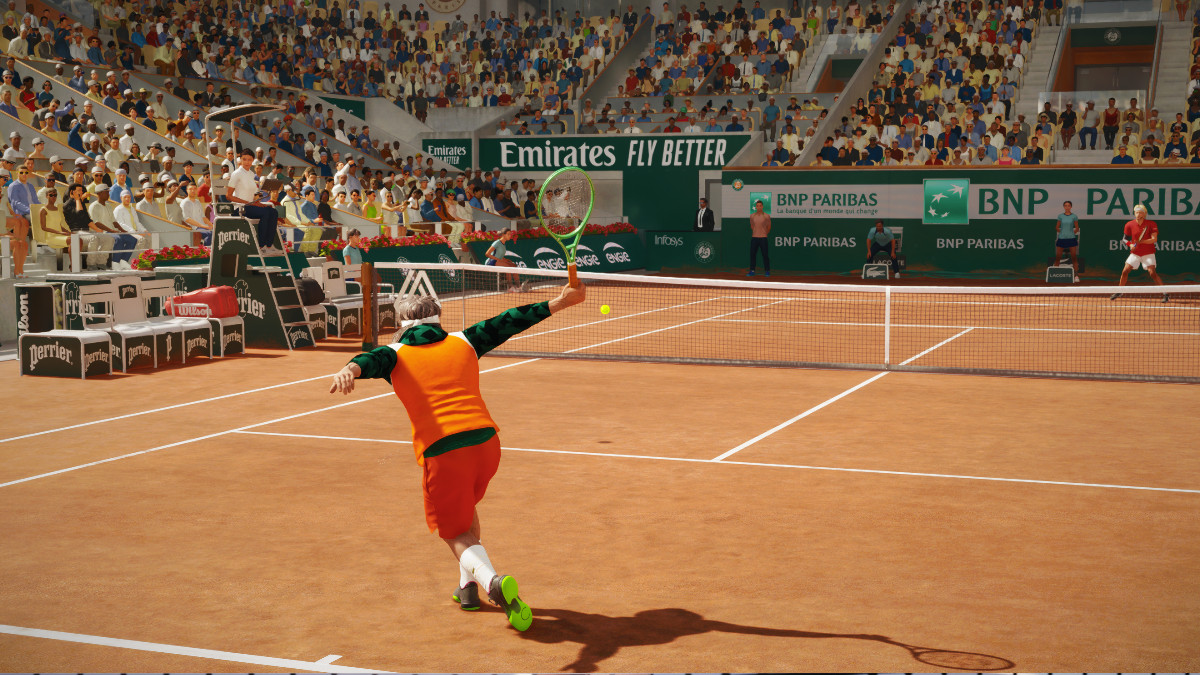

The Last of Us "Squeezes Every Last Drop of Power" From PS3 Pages PREV 1 2 | |
It really is a shame though from what I've seen the PC people have their threads of discussion and play nice but when it's a console only thread they tread in and harp on like it's their gospel and I really don't see a need for PC talk in a console thread that's about a console and not a PC regardless of what people try leading it towards. A good chunk of people here already know what PC's are capable of but still get the same facts repeated over and over again in some twisted form of making console people feel inferior/stupid for buying one and not a PC. I'm a console and PC player but I've never once felt the sudden urge to talk someone down for choosing a console and not choosing a PC and vice versa because I know they have their own choices to make. | |
Don't forget the "x" number of consoles it'll probably brick. | |
Ha, me too. OT: Can't wait to see what explosions do to the framerate. | |
See, when developers say that they've 'squeezed every last drop of power' from a console, the cynic in me automatically translates it to: "We've managed to reduce FOV, get rid of off-screen loading and downsize level size enough that we can have even higher poly-count models in our games. Of course, it means our game is now one giant corridor, but at least it looks pretty." Console limitations aren't some elastic thing. It's not as if by pushing a little harder, you can push them just a little further. Consoles have hard, set limitations. No matter how much you try, you're not getting more than 512mb of RAM, or 256/256mb in the PS3's case. Wishing on a star won't make that amount any bigger. And that means if a developer has managed to push polygon counts in their game, that'll be at the expense of something else. Again, 512mb will only give you so much, and you can't have pretty graphics and extensive animations, large levels and lots of dialogue. The sad thing is, we shouldn't be focusing on prettier graphics anyway. Gameplay should always come first. All the graphical improvement in console games has come at the removal of other options, which directly impacts on gameplay. The inability to holster weapons in ME3. The inability to dual-wield weapons in Halo 4. If developers started focusing on gameplay over graphics, not only would they stop their budgets ballooning horribly, they'd actually give players more fun ways to interact with their games.
You're not talking about innovation. You're talking about shortcuts. The problem is, those shortcuts can and do negatively impact on gameplay. Reducing the FOV players have in an FPS drastically reduces their ability to accurately respond and shoot at what's going on around them. Removing dual-wielding in Halo 4 reduces the options players have to improvise different weapon setups like they could in Halo 2 and 3. This isn't a good thing for gaming. Developers should have the freedom to be able to offer us all the gameplay necessary to make a good experience, not cutting out features in order to make space for better textures. | |
Bungie removed dual-wielding from Reach and 343i from Halo 4 because it's a bitch to balance. They have both stated it that it's better to have one good weapon then a weapon that is nigh worthless without dual wielding. The pistol was amazing alone in Halo 1 but when they added dual wielding to Halo 2 the pistol was pointless to use if you didn't have another gun. Or in some cases where the Needler was so powerful alone and broken together. | |
So there were rain effects, for instance? I recall a video where someone was showing the flaws in the environments, and, for instance, you could shoot a tree and I don't think it even got marked up. Still, again, Halo 4, from what I saw, was an amazing achievement on 7 year old technology.
For me, if you are going to boast what your game is going to look like, you really have to offer something new. When this gen came out, a normal PC owner couldn't match what they were doing. My hope is, PS4 and 720 will outdo anything our PCs are doing and once again, offer us something new. | |
It's got to be said now. I didn't want to, but listening to half a page of smart-arse comments from the Master Race has forced my hand. PC gaming is shit. End of. And before you try to attack my gaming pedigree, I cut my teeth playing Chocs Away and Alien Invasion (Space Invaders on steroids) on an Archimedes; a computer most of you have likely never heard of. I rocked my way through Ascendancy, Total Annihilation, Red Alert, Mechwarrior 2: Mercenaries and more besides. I've sunk eight years on and off into MMORPGs. I've currently got Starcraft 2, Minecraft half the Total War franchise, Blood Bowl and Space Marine ready to play via desktop icons. And I still say it's shit. The control system is flat-out TERRIBLE for shooters or combat games or platformers. RTS games only get a pass because these days they are so fucking convoluted they're barely playable WITH 50+ buttons, nevermind twelve and a pair of joysticks. I won't even go into the hardware issues - my PC's specs should be able to run Space Marine on top spec no problem, yet even with everything set to minimum I get terrible spikes of latency. No such problem on the PS3. PCs will NEVER be as good for gaming as consoles will. | |
I never understood this whole culture of wanting the next instalment to look and perform significantly better. Sure I guess you want to have pride in your work and do the absolute best you can... but if Naughty Dog's subsequent games all remained at the same level as Uncharted 3, I would be quite happy! Their visuals and animation is leagues apart from most other triple A devs. | |
The whole existence of computer programming is about working around hardware limitations. If we didn't compress films, we'd max out a blu-ray disk before we actually got past the DVD menu. Thats how good we are at working round hardware limitations. That#s not an exaggeration either, every single frame of a film is 144mb uncompressed, 8GB per minute. And it's not like we're even close to pushing the boundaries of how much we can work around hardware limitation. P=NP is one of the millenium maths problems, and if it turns out to be true and is solved, then potentially we have the ability to absolutely slash the amount of processing power needed to do anything. Decision maths and linear optimisation are very very young maths subjects, several 1000 years younger than some forms and we're finding new optimisation algorithms all the time. The more we work on that the better and better we can get round these limitations. We've come unbelievably far, if we didn't do the work we had done, we could have nothing like the games we make now, but there's much exciting possibilities out there for further advancement. I mean look at what ID can make run on a smartphone, the industry wasn't even close to that kind of skill level. ...at the same time, whilst we can get much better at optimisation I would agree that you'd have to expend a lot more effort for less return than just giving us new hardware would. The post you were responding to makes it sound like developers were just being lazy (and okay, maybe Bethseda are a bit lazy on the tech front. Apparently in Oblivion, each blade of grass had 28 polygons, when really you needed only 4,8 tops) which isn't true. | |
The better the hardware is, the easier it is to make things on it. In almost every single case. The better the hardware, the less time you have to spend trying to optimize and downscale to get something that's at best the bare minimum of the game you want to make run at a passable framerate, or run at all. I'm not exactly sure what you're trying to say here, but if you're saying that it's good in terms of efficiency to work within these sorts of limits for as long as these consoles have been out already, then you're simply wrong. The better the hardware, the less effort is required to make the same thing, and more avenues become available. This is an absolute truth.
And exactly why would you want them to keep prodding this old hardware that is, at this point, blue in the face grasping for air, disemboweled, with hemorrhoids and chronic diarrhea, when they can simply move on to a better system and do ten times as much with less effort than it takes to do this? | |
some factors: - It takes roughly an entire cycle, as the devs have stated, to master a system's capabilities and nuances in order to utilize them to the full potential. Then that knowledge gets tossed out of the door for the new system, so that they have to learn it all over again. The knowledge goes largely wasted. You would think it would carry over, but then, somehow, somebody screwed up the Silent Hill collection. Hmmmm. (yes, i realize that there are a number of factors involved with the mess up, but even if they had to build that thing FROM SCRATCH you would think, hey, maybe it would be relatively simple to rebuild a game where you already know how everything happened, right? i mean, just going by that logic...) - During this period of learning, the new system is underutilized, mismanaged, or in many cases involving the PS3, outright inferior to an older system in some ways simply due to certain hardware changes/decisions that cause more complications than they're worth. In addition, with each scaling up of complexity, the cost of developing the same amount of content, while matching the higher level of graphical (and in some cases, audio) fidelity, increases dramatically for the developer, which leads to games like Skyrim, which feels more empty than Oblivion, since sacrifices have to be made in other areas to accommodate for theses costs and resource development time. In the worst case scenarios for triple A games, as the stakes grow higher and the development scales ever much larger, there is more room for error, less room for innovation, and more pressure to deliver, which then leads to companies resorting to more devious pay schemes in order to feed them, for an experience that may not necessarily be better, or even worse off than before. Then everybody ends up angry or unhappy and wonders where the fun went or why we have to keep paying more for stuff we don't want or need. - Consoles, due to having to stick to a price point, are ALREADY behind when they're new, so pushing for a new console hasn't significantly improved the gameplay to the point where the "pc master race" hasn't already been there, doing it better. A console's strength is not the sheer graphical power or how many hardware specs you can rattle off a sheet, but the accessibility, and the common platform which allows devs to aim for a specific set of parameters freeing them up to play in the safety of this sandbox. This is weakened by a smaller cycle. Smaller cycles mean that consumers must pay more often, companies have to pay for more new systems (as they foot a large part of the bill to produce and distribute them!), and these systems have to establish themselves as a legitimate platform before market development sets in place long enough to make money, during which time everybody hemorrhages lots of money for development and low initial sales compounded by easily possible launch hiccups. In the meanwhile, devs are pressured to come up with quality content that fits the platform's capabilities within a time span that people don't consider "too late", which given all of our previous experience, never happens and those titles get pushed back. Early launch games consist of either tech demos or things that were ported over or otherwise easy to make with pre-existing assets. The exceptions are games that Nintendo purposely develops alongside the hardware deep in their fortress of solitude, and since they pushed up their development cycle to cut off the other two at the pass, even those games ended up later in the release, or as they were before that happened, exactly where they were going to be to begin with. - In the past, while games were limited by their hardware, it did not actually stop them from being great, or fun. In particular, during the 32-bit era, the games market just exploded in creativity and charm. Japanese games are especially famous for making insane games possible on these systems that seem primitive compared to the capabilities we have now, but there has not been significant progress since that time which has matched that amount of work to game experience (if we include the time spent on the PS1/2 where they simply expanded on that work, while not necessarily utilizing much more of the added features). The plaintiff calls to the court one Square Enix (which during this time was not merged), which since turning over their development towards the graphical side of things, has not produced a Final Fantasy game quite like the sixth one, which is so long and epic and does so many different things that work together that you have to wonder what the hell happened to them after that. now, it wasn't always like this, i believe two primary factors contributing to this is that a lot of pc developers moved to consoles to chase money and ended up trying to make the consoles conform to pc standards with...mixed results, and as the environment grew increasingly corporate, the corporate influences tainted the development cycle and pushed towards profits instead of quality | |
Oh, by the way, the quote in the article is just priceless in its terribleness. Just pathetic, meaningless where not outright wrong babble.
See, the thing is, the consoles don't exist in some sort of a vacuum; if it were true, I'd heartily agree. And since we're talking about hardware, especially hardware that basically dictates the standards of AAA gaming, saying "Hey, people, what's the big deal? You're sluggishly approaching a point that was not particularly spectacular 5-6 years ago." is almost as relevant as it gets. If you don't like hearing it or if you think it's preachy or something, I'm sorry, but it's the truth, and some people don't quite like that truth. Hence, they express themselves on a forum. Don't expect every (or any, really) thread to be a circlejerk where nothing negative is said. A good chunk of people here already know that, that's true. A good chunk of those people don't, though, understand just how weak the console hardware is in relation to that, though, and there's another good chunk that knows nothing about anything and still thinks the consoles have some sort of long journey ahead of them in terms of their capabilities. I'm likely going to start sounding like a broken record at this point, but this is a detail crucial enough to warrant point out in every thread with this sort of "don't insult me"/"don't talk down to me"/etc sentiment. Detach yourself emotionally from the hardware you own. This cannot be said enough. Me saying a PS3 is weaksauce does not, really, say anything about you. It only does if you define yourself by the PS3, in which case, your own damn fault.
People forced your hand into expressing your opinion? Please. Or do you mean they forced you to just say something contrarian in spite? The strike-through'd part has nothing to do with anything. I don't care how many games you've played or over how long a period, and I doubt anybody does. Your preemptive strike is both unwarranted and irrelevant. Getting to the bolded part, and... You're wrong, and this is basically the first thing you say. I'd give you a couple of points if you actually reasoned out any of your bold criticisms, but you didn't, so you get nothing. Beep. Try again. On the topic of shooters specifically, and why you're blatantly wrong on that, I've got one word for you. Mouse. The mouse replicates hand-eye coordination, the analog stick doesn't (it's also more responsive, among other things, but this is the main one). It's roughly the equivalent of the difference between pointing at something with your own hand and then doing the same with a robotic one you'd control with an analog stick. Then there's also the fact that mouse vs. analog shooters have been tried before, and on average, mouse users wipe the fucking floor with analog users. And while we're talking about Shadowrun, this game was designed with the controllers' deficiencies in mind, making the game not as aiming intensive as certain other FPS games, the target reticule specifically designed to be inaccurate (your shots will go somewhere around where you're aiming, not directly there), the controller users still got their auto-aim[1] and the mouse users were actually purposefully gimped by at least one design decision that I know of that further screwed with the accuracy if you turned fast. Controller users still got their asses spanked. Your little assertion here is nothing. It's not substantiated in any way, either theoretically or practically, in fact all the evidence goes the other way. I'd say more, because there are some very valid things to say about what each platform is good for, but I have a feeling that'd be a waste of time. [1] You're free to explain why this even exists, by the way. | |
I'm not sure exactly what you're trying to address here, but let's see. -Okay. Let's say for the sake of briefness and simplicity, that moving on to a new platform renders the knowledge gained from previous platforms largely useless (which is wrong, by the way. I'm doing this for the sake of argument). What are you, then, trying to say? Are you saying they shouldn't move on simply because of the fact that they spent time trying to understand the previous platform? Even despite the fact that the limit they're slowly approaching could be blown out of the water with less effort on a new platform? -Eh, I don't know much about the PS3, but I know a couple of things for sure. PS3's launch games looked far better than anything on PS2, straight up. Maybe not all of them, but the higher processing power was being used to some decent extent of efficiency right off the bat. And if even with the underutilization or mismanagement it still comes out at a far higher level of fidelity (if nothing else), I'd say we're looking at a straight up improvement, albeit a not yet polished one. I'm seriously hoping you're not saying the PS3 was a mistake (in as much as it existing, not its particular specs). I've never really understood the argument about rising development costs. You do realize what moving on to a more powerful platform does, don't you? It loosens the restraints on developers - that's it. It allows you to do the same things far easier, in fact there's an increase in the level of quality that would without any cost in terms of effort. Most of the obscene amount of downscaling and optimization required to get any AAA out the door on a console at this point - gone. And gone with it the pathetic blurry textures (that are, in a lot of cases, a direct result of downscaling from far better resolution ones), objects popping in 5 meters in front of you and many other things. We're talking about giving developers better tools here, tools that allow them to do more. The last thing I'm concerned with is bad developers who can't plan their shit right, or a corporate system fucking themselves up the ass with misguided development strategies. If you're given a hammer and the best you can do is nail your hand to the table, tough luck. Let more competent people take your place. -Nobody (reasonable and/or knowledgeable) expects the consoles to be some sort of unbeatable beacon of gaming supremacy on almost any level. They are stagnant and limited as all hell, however, and if you don't see a problem with that, that's where the conversation ends. If you think these consoles do everything you'll ever want, that's your prerogative. The facts that a new console cycle costs money for the poor consumers who would rather stay with their PS2s for 20 years, that companies releasing those consoles hemorrhage money, or anything else even remotely in that regard, are completely irrelevant. What I care about, and what I'm talking about here is the quality of the games. This sort of "danger, people might drown themselves if you let them swim" rhetoric is the last thing I'm worried about. You don't have to try and get to the bottom of the deep end of the pool, the shallow end is still there and it always will be. If you seriously think the factual, absolutely certain loosening of the constraints on developers and the skyrocketing potential for gaming is not worth the potential failures, well, I've no idea what to say to you. Even as a massive cynic on a depressing level, if you really hold this opinion, I have to say that you have too little faith in the gaming industry (and that's not to say the corporate side of it) or creativity and ingenuity in general. And by extension, as someone who sees just how far we've already gone on our somewhat short journey, that you don't appreciate the progress that's already been made. | |
the point i was trying to make (which gets muddled often, i admit) was that bigger consoles are usually an OBLIGATION to hit the deep end of the pool in order to demonstrate the capabilities and validate the presence of the hardware sure, they don't HAVE to theoretically but usually somebody's pressuring them to do so (unless it's like, a niche game which somehow has full control of the project direction) even if it's not always the best idea for every game anyway, if previous console experience isn't totally wasted on new consoles, why do we see a large bunch of failures to transition with each new cycle? shouldn't people who were totally good with the previous cycle have less trouble adapting? on a side note, i meant that game costs are increasing for EVERYBODY, not just "poor consumers" because games actually cost more these days because what would have been included with the main game is being appropriated to DLC and online components are now being charged for, but for developers whose overhead continues to rise as the high end is being pushed, in addition to whatever executives are doing to fatten the bottom line without considering how it would detract from the experience should a studio die when they don't absolutely succeed on their first game? anyway, our games might have more visual capabilities but i'm not sure if they've improved enough to increase the costs as they have been doing for the last few years, nor has their length of quality gameplay changed that much, if not gotten shorter without tightening the experience in any way (save for multiplayer games, which frankly are hit or miss) if we look at the recent games that have truly been great experiences, how many of them actually NEEDED the full capabilities? | |
Is there some sort of obligation to make use of the hardware you're working with, given that something is gained by that and you aren't working on a shoestring budget? Sure, absolutely. It's irrelevant though. As a developer or publisher, it's your job to worry about how much time and money you're going to spend on each particular aspect of a game. I don't think there's an obligation on the part of gamers/other developers/hardware manufacturers to worry about incompetents fucking up. Because there will certainly be lots of people who won't, and the last thing I want to see is those people getting dragged down by the short-sightedness and imbecility of others. This sort of rhetoric is portraying the gaming industry as some sort of an irrational, thoughtless and inconsiderate entity that would cease to function had the constraints been lifted, which is simply, absolutely, not going to be the case. It's not going to be the case in even a majority of big developers' cases. I won't say all, because there's a degree of separation from the gaming industry or even common sense in the corporate world that I can't account for.
I have little clue what you mean there. Be more specific and provide examples if possible.
Bullshit.
Basically the same goes for the actual games of the past. From what I see from googling around, new N64 games were going for 60 dollars a pop, which is just insanity. The thing is, those games of the past were generally extremely shallow, simplistic, ugly and otherwise cheap. In comparison to games of today, people now are getting a hell of a bang for their buck. Maybe there is some grain of truth to it, but it really has next to nothing to do with the actual technologies being used.
What does this have to do with anything? If you want my opinion, a studio should die when they care more about making money than making good games. In the real world, if people don't buy enough of your product to justify further investment, you're going to die. I'm not sure I grasp the point you're trying to make.
Well I have little idea of what to say, then. Better graphics require more development time, and the jump from PS2 from PS3 as an example was absolutely tremendous. I'm really having a difficulty grasping what you're "not sure" about here. The length of the games may not have changed much, but that's a next to meaningless expression. A game's length is not directly correlated to the technology it uses, and one type of gameplay is not equal to another. It may have decreased as an average, but there are cases to be made as to the quality and density of the gameplay, or other such properties in analogous games.
What kind of a question is this? Games don't "truly need" much of anything other than being interactive. Even on the most shallow level, better visuals - polycounts, textures, lighting, physics - improve everything. It may only have a small influence on the overall quality of the game (especially depending on the type of game it is), but even if you (rhetorical you, not you) are one of those people who mindlessly repeat the slogan "graphics don't matter", I'd have to call bullshit on you if you said that given the choice of playing Counter-Strike 1.6 or Counter-Strike-Source (possible minor gameplay changes notwithstanding), you said you'd flip a coin. Graphics do matter, and the better they get the bigger the potential for awesome scenes, setpieces and everything else gets. Now to actually answer the question in some form, first - no physics heavy games could actually make it on previous gens of consoles. Battlefield, From Dust, whatever. You could make gimped versions of basically anything, but any sort of cinematic game (Uncharted or Heavy Rain being prime examples) would lose almost all of its appeal and/or look downright stupid if it existed on the previous generations of consoles. I doubt anybody would give two shits about Journey were it made for the PS2. And the thing is, even for the games that don't ostensibly need great hardware, they come out far better with it. | |
Nitpicking aside, congratulations, you've maxed out a console that's more than 6 years old. Now go ask Sony for a console with more RAM, so we can have bigger and more open levels. Or, you know, just start developing for pc. | |
| Pages PREV 1 2 | |
Such is the way of the escapist. You can't make a console thread without PC elitists.