


In terms of milestones, the 35th anniversary of over-the-top action hero Duke Nukem seems like generic news-cycle churn, but there is a little more to the legacy of this intellectual property, which has left a radiation burn on video game history.
- A blunt instrument
- Pop culture collisions create a financially successful monster
- Building a nuclear engine
- Nukem’s lasting legacy
- Legal precedent on the back of excess
- Duke Nukem turning 35 in 2026
This isn’t a tale about a nostalgic throwback to a much-beloved character, although the cigar-smoking psychopath has his fans; it’s about the backbone of copyright, the grassroots of mod builds, and a certification from the British Board of Film Classification (BBFC) that defined his once-dominant perch atop the first-person food chain.
A blunt instrument
At the height of the shareware distribution boom of the late 1980s and early 1990s, demo discs and playable single levels were instalments of monthly publications that lined the racks of bookshops and retail chains.

A game snippet had to establish tone immediately and leave an impression strong enough to justify purchasing the rest. Anything abrasive travelled like wildfire, and the more fast-paced and aggressive, the better, for a lightning round of commercial success that spanned the early 1990s.
Entries like Duke Nukem (1991) and Duke Nukem II (1993) fit that model of instant gratification and linear gaming.
They were competent 2D side-scrollers, and Duke existed, but only as a functional avatar, not yet the parody of toxic masculinity shaped by Todd Replogle, Jim Norwood, George Broussard, and Scott Miller.
Pop culture collisions create a financially successful monster
Magazine journalism was red-hot on video games, movies, VHS, and heavy metal. The information superhighway was still evolving; print and word of mouth ruled supreme.
Metallica released The Black Album. Slayer’s Seasons in the Abyss and Pantera’s Cowboys from Hell roared into circulation.
Arnold Schwarzenegger returned to cinemas as the Terminator in Terminator 2: Judgment Day and remained a fixture of dystopian action cinema through films like The Running Man.
To best describe Nukem, he is a bootleg Frankenstein’s child of heavy metal, pop culture, and hyperviolence, a combination that flourished across 1990s video game media and would indirectly feed the rise of early modding culture.
Building a nuclear engine
A common misconception about Nukem and the legendary Doom franchise is that they share the same engine. This isn’t the case; both followed distinct design philosophies that led to the success of one and the eventual shelving of the other.
Ken Silverman, who began his development career as a teenager, later created BUILD.EXE, commonly known as the Build Engine. This powered the most recognisable iteration of the character in Duke Nukem 3D (1996) for Apogee, later rebranded as 3D Realms.
Silverman made the editor and development tools widely available, alongside documentation that later enabled source-level tinkering and catalysed early modding interest as the 2000s crept up.
Silverman, 3D Realms, and their work were complemented by the sound of Lee Jackson and the use of the Musical Instrument Digital Interface (MIDI) to create an abrasive, repetitive, heavy-metal soundtrack and the iconic voice of Jon St John as Nukem.
In contrast, Doom and John Carmack’s id Tech engine functioned like a streamlined fullsteam ahead simulator, driven by speed, momentum, and the rapid tones shaped by Robert “Bobby” Prince.
It was a perfect cyclical loop for id Software, eliminating the need for a character entirely, and the Doomguy’s lack of empathy only hardened his cultural appeal.
Nukem’s lasting legacy
The game’s setting is an irradiated Los Angeles, and the police are warped into grotesque swine known as Pig Cops, an unmistakable middle finger to law enforcement. 1990s America had been through a lot, especially Los Angeles, where Duke’s dystopian world is set.

Former Gearbox boss and Duke Nukem developer Randy Pitchford later commented on the Pig Cop enemies, writing:
“How do we create a world where no cops are Pigcops?”
The remark came amid wider discussions of systemic injustice and the spectre of the Los Angeles riots following the beating of Rodney King.
As a result of its satire, Robert Grace gun-toting cover, and heavy use of violence, sexual humour, and language, regulators cracked down on the title, a response that became a badge of honour for Duke Nukem 3D.
In the UK, the game received an 18 classification from the BBFC, placing it alongside adult cinema at a time when games were still widely treated as toys.
Legal precedent on the back of excess
It seems surreal to think of such an anti-establishment character becoming an epitaph for copyright enforcement and the red tape of legal ownership.
In the mid-1990s, Apogee Software made a quiet but decisive legal move by registering the Duke Nukem trademark with the United States Patent and Trademark Office, consolidating ownership of the IP.
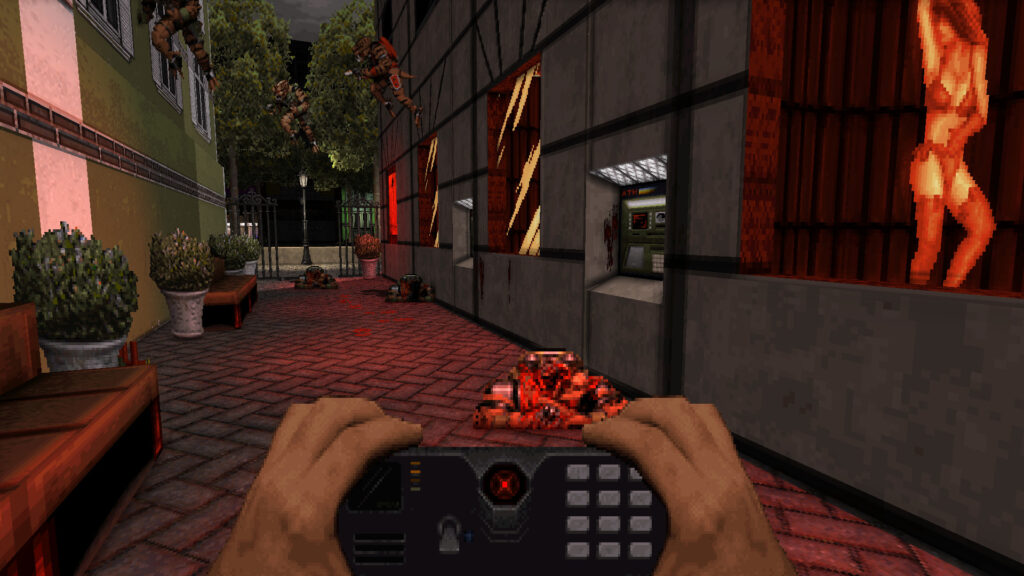
That early act of trademark control set the framework and precedent for video gaming lawsuits, publisher disputes, and ownership transfers.
These issues are best represented in Take-Two Interactive Software, Inc. v. 3D Realms Entertainment, LLC (2009–2010), followed by disputes between 3D Realms and Gearbox Software, and later by Gearbox Software v. 3D Realms/Interceptor Entertainment (2013–2015).
Duke Nukem turning 35 in 2026
So, approaching middle age for the old Duke doesn’t come with a fanfare rebrand or an eagerly anticipated return to the irradiated Hollywood he stomped around in.
Nukem’s legacy isn’t in his channelling of the chaotic pop culture forces that shaped him. He has had a greater impact on copyright precedents and regulation, and a small role in the early days of modding.
He once quoted Han Solo, “Sometimes I even amaze myself,” but he is also known for saying, “If there was a way to go, I’d have something to do with women, whips, and oil…”


Last Updated On: Jan 15, 2026 11:59 am CET